


Helminthiasis (helminthic infestation): causes, symptoms, diagnosis and treatment methods.
ABOUTdetermination
Helminthiases are diseases of humans, animals and plants caused by parasitic worms (helminths).
Causes of helminthiasis
Currently, more than 70 species of the known 250 helminths that parasitize the human body are found in our country.The most common are roundworms (roundworms, pinworms, trichinella, whipworm), tapeworms (pork, bovine and dwarf tapeworms, broad tapeworm, echinococcus), and flukes (liver and cat flukes).
Helminths are characterized by stages of development: eggs → larvae → sexually mature forms.
Infection with helminths most often occurs after their eggs and/or larvae enter the body.Depending on the mechanism of infection and routes of transmission, helminthiasis is divided into: geohelminthiasis, biohelminthiasis and contact helminthiasis.Geohelminths develop without intermediate hosts, biohelminths develop with a sequential change of one, two or three hosts, contact helminths are transmitted by contact.
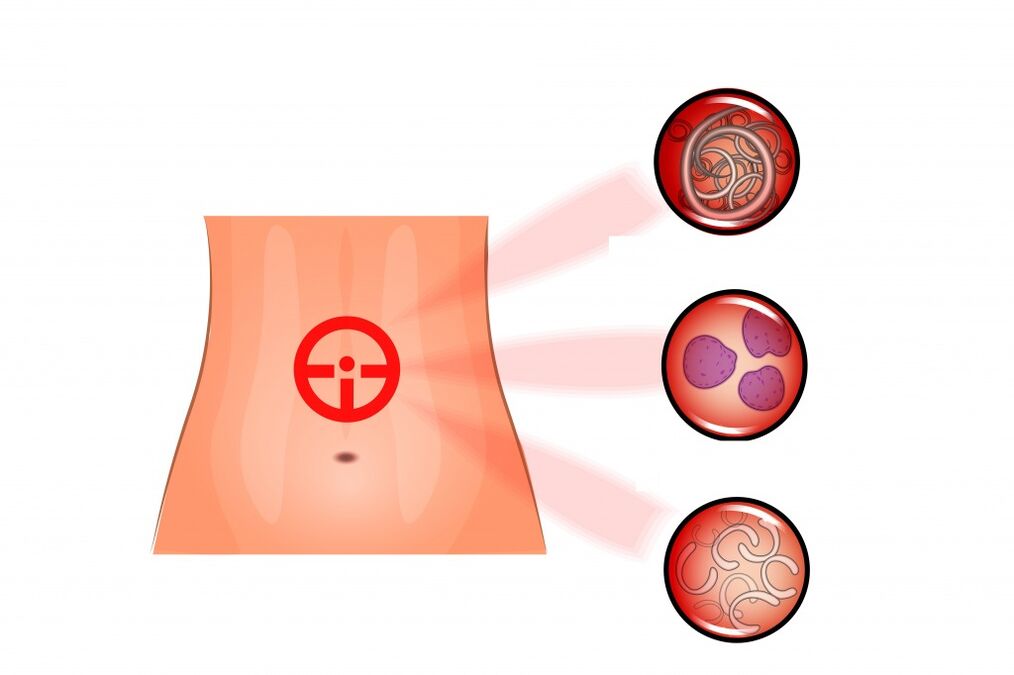
Pork tapeworm, bovine tapeworm, echinococcus and other types of worms develop with a successive change of one, two or three hosts.Intermediate hosts can be fish, mollusks, crustaceans, and insects.A person becomes infected with these helminths by eating foods that have not undergone full heat treatment:
- beef meat infected with bovine tapeworm larvae;
- pork affected by Finnish pork tapeworm;
- lightly salted and raw fish with larvae of opisthorchis or broad tapeworm;
- raw water or vegetables and fruits treated with this water.
Whipworm, roundworm, hookworm, and necator develop without intermediate hosts.The eggs and larval forms of these parasites enter the soil with feces.If the rules of personal hygiene are not observed, they penetrate the body of a new host.
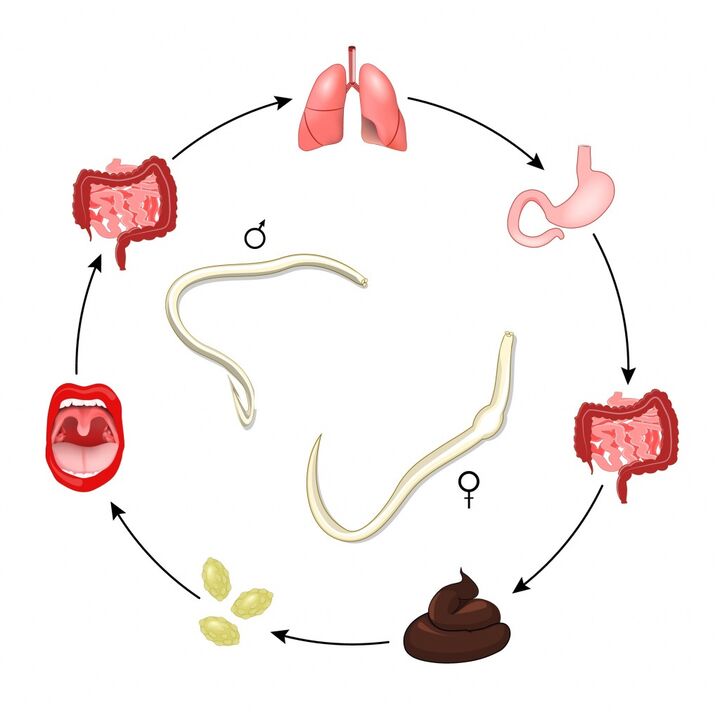
By contact - that is, through personal contact between a healthy person and an infected person, through the use of shared utensils, toiletries, linen, and through inhalation of dust in a room where an infected person is located - enterobiasis (pathogen - pinworm) and hymenolepiasis (pathogen - dwarf tapeworm) are transmitted.In the case of enterobiasis, self-infection often occurs.
Helminths of a certain type parasitize in certain organs, causing various helminthiasis:
- in the large intestine - pork, bovine, dwarf tapeworms, nematodes (hookworms, roundworms, strongyloides), pinworms, whipworms.From the intestinal lumen, pork tapeworm larvae can enter the bloodstream and spread throughout the body, settling in fatty tissue, muscle vessels, chambers of the eye, and brain;
- in the liver and biliary tract - trematodes (opisthorchis, clonorchis, fasciola).Echinococcal cysts are primarily located in the liver, and after their rupture, daughter blisters can be found in the mesentery, peritoneal layers, spleen and other organs;
- in the respiratory organs - echinococci, alveococci, pulmonary flukes, causing paragonimiasis;
- in the nervous system - schistosomiasis, paragonimiasis, echinococcosis and alveococcosis;
- in the organs of vision - oncocerciasis, loiasis, complicated forms of taeniasis;
- in the circulatory system - necatoriasis, schistosomiasis, diphyllobothriasis;
- in the lymphatic system - filariasis, trichinosis;
- in the skin and subcutaneous tissue - hookworm, oncocerciasis, loiasis, larval stage of schistosomiasis;
- in the skeletal system - echinococcosis;
- in skeletal muscles - trichinosis, cysticercosis of muscle tissue.
The lifespan of helminths in the body of the definitive host can be different, depends on the type of parasite and ranges from several weeks (pinworms) to several years (tapeworm) and decades (fasciola).
Classification of the disease
There are two types of worms that parasitize humans:
- Nemathelminthes – roundworms, class Nematoda;
- Plathelminthes are flatworms, which include the classes Cestoidea - tapeworms, Trematoda - the class flukes.
Depending on the routes of spread of parasites and the characteristics of their biology, they are distinguished:
- biohelminthiases;
- geohelminthiases;
- contact helminth infections.
Symptoms of helminthiasis
Helminths have different effects on the human body:
- antigenic effects, when local and general allergic reactions develop;
- toxic effect (waste products of helminths cause malaise, weakness, dyspeptic symptoms);
- traumatic effect (when parasites are fixed to the intestinal wall, the blood supply is disrupted with necrosis and subsequent atrophy of the mucous membrane; absorption processes may be disrupted; mechanical compression of tissues by helminths);
- secondary inflammation as a result of the penetration of bacteria following migrating helminth larvae;
- violation of metabolic processes;
- as a result of the absorption of blood by some helminths, anemia occurs;
- neuro-reflex effect - irritation of nerve endings by helminths provokes bronchospasm, intestinal dysfunction, etc.;
- psychogenic effect, manifested by neurotic conditions, sleep disturbances;
- immunosuppressive effect.
Helminthiases are characterized by stages of development.Each stage is characterized by its own clinical symptoms.
In the initial acute stage, helminths most often do not yet release eggs, sensitization of the body occurs (production of antibodies, release of inflammatory mediators, increased permeability of the vascular wall) and traumatization of the organs through which the larvae migrate.Clinical symptoms may be absent, but in some cases the disease can occur with pronounced clinical manifestations.The acute stage lasts from 1 to 4 months, sometimes 8-10 months or more.
Complaints from patients in the acute stage:
- increased temperature from several days to two months (low-grade fever or above 38ºС, accompanied by chills, severe weakness and sweating);
- itchy recurrent skin rashes;
- local or generalized edema;
- enlargement of regional lymph nodes;
- pain in muscles and joints;
- cough, asthma attacks, chest pain, prolonged catarrhal symptoms, bronchitis, tracheitis, symptoms simulating pneumonia, asthmatic syndrome, hemoptysis;
- abdominal pain, nausea, vomiting, stool disorders.
At the end of this stage of helminth infections, acute allergic phenomena gradually subside, and the clinic of the chronic stage has not yet had time to develop.
The acute stage becomes subacute when the “young” helminths gradually mature.Then comes the chronic stage, corresponding to the development of parasites into sexually mature individuals.The clinical picture develops against the background of the toxic effect of helminth waste products, the traumatic effect of helminths on organs (hookworm, trichuriasis, etc.), mechanical effects (an echinococcal cyst in the liver grows, compresses neighboring organs; cysticerci - in the brain), a secondary inflammatory process (duodenitis is observed in strongyloidiasis), metabolic disorders(hypo- or avitaminosis), functional disorders of the stomach and duodenum, secondary immunodeficiencies, etc.
Symptoms depend on the organs in which the helminths parasitize, their size and quantity.
Forintestinal helminthiasesThe following syndromes are characteristic:
- dyspeptic (stomach discomfort, feeling of fullness after eating, early satiety, bloating, nausea);
- painful;
- asthenoneurotic (feeling of extreme fatigue, increased nervous excitability and irritability).
Enterobiasis is characterized by nocturnal perianal itching.With massive infestation by roundworms, there may be intestinal obstruction, pancreatitis, obstructive jaundice.
Intestinal cestodoses(taeniarinhoz, diphyllobothriasis, hymenolepiasis, taeniasis and others) are asymptomatic or with a small number of symptoms (with symptoms of dyspepsia, pain, anemia).
Liver trematodes(fascioliasis, opisthorchiasis, clonorchiasis) cause:
- chronic pancreatitis;
- hepatitis;
- cholecystocholangitis;
- neurological disorders.
Hookworm diseasemanifested by asthenovegetative syndrome (weakness, fatigue, pallor of the skin) due to the development of iron deficiency anemia.
Filariasis is characterized by an allergic syndrome of varying severity and regional lymphadenitis.
Urogenital schistomiasismanifested by the appearance of blood at the very end of urination, frequent urge to urinate, pain during urination.
Alveococcosis, cysticercosis, echinococcosismay remain asymptomatic for a long time.At a later stage, suppuration or rupture of cysts containing parasites leads to anaphylactic shock, peritonitis, pleurisy and other severe consequences.
For diseases caused by parasitism of migratory larvaezoohelminthswhen a person is not the natural host, distinguish between cutaneous and visceral forms.The cutaneous form is caused by the penetration of certain animal helminths under the human skin: schistosomatids of waterfowl (trematodes), hookworms of dogs and cats, strongylids (nematodes).When a person comes into contact with soil or water, helminth larvae penetrate the skin.There is a feeling of burning, tingling or itching at the site of introduction of the helminth.There may be a short-term fever and signs of general malaise.After 1-2 weeks (less often 5-6 weeks) recovery occurs.
The visceral form develops as a result of ingestion of helminth eggs with water and food.At the onset of the disease there may be malaise, allergic exanthema (skin rash).In the human intestine, larvae hatch from helminth eggs, penetrate through the intestinal wall into the blood, reach the internal organs, where they grow and reach 5-10 cm in diameter, compress tissues and disrupt the function of organs.When tapeworm larvae (cysticerci, tsenura) are located in the membranes and substance of the brain, headache, signs of cerebral hypertension, paresis and paralysis, and epileptiform convulsions are observed.Larvae can also be located in the spinal cord, eyeball, serous membranes, intermuscular connective tissue, etc.
The outcome of helminthiasis can be complete recovery with the elimination of helminths or the development of irreversible changes in the host’s body.
Diagnosis of helminthiasis
The diagnosis of helminthiasis is established on the basis of a combination of complaints, information received from the patient about the course of the disease, data from laboratory and instrumental examination methods.
In the acute phase of helminth infections, there is a blood reaction to the presence of a helminth in the body, therefore the following studies are recommended:
- clinical blood test: general analysis, leukoformula, ESR (with microscopy of a blood smear in the presence of pathological changes);
- biochemical blood test:
- total protein, albumin, protein fractions;
- assessment of kidney function indicators (urea, creatinine, glomerular filtration);
- assessment of liver function indicators (bilirubin, ALT, AST, alkaline phosphatase);
- alpha-amylase pancreatic;
- assessment of carbohydrate metabolism: glucose (in blood), glucose tolerance test with determination of glucose in venous blood on an empty stomach and after exercise after 2 hours.
The following biological materials can be examined for the presence of helminths: feces, blood, urine, duodenal contents, bile, sputum, muscle tissue, rectal and perianal mucus.
Since helminths are not excreted in feces at any stage of their development, it is recommended to donate feces three times - every 3-4 days.
- Analysis of feces for helminth eggs.
- Test for enterobiasis (pinworm eggs), swab.
- Microscopic examination of stool to detect eggs of the enterobiasis pathogen Enterobius vermicularis (pinworms).
- Test for enterobiasis (pinworm eggs), spatula.
- The analysis is necessary if there is a suspicion of pinworm infection, as well as during hospitalization and registration of a medical record.
- Analyzes for kindergarten and school.
The child examination program is intended to be completed before entering kindergarten or school.The results of these studies are necessary to obtain a medical certificate in accordance with form 026U approved by the Ministry of Health of the Russian Federation.
Conduct immunological studies - determination of specific antibodies to helminths:
- antibodies to roundworm IgG;
- anti-Echinococcus IgG;
- IgG antibodies to Toxocar antigens;
- Anti-Opisthorchis felineus IgG (IgG class antibodies to cat fluke antigens);
- IgG antibodies to Trichinella antigens;
- antibodies to the causative agent of anisakiasis (nematodes of the genus Anisakis), IgG;
- antibodies to the causative agent of clonorchiasis, IgG;
- Antibodies to Strongyloides stercoralis, the causative agent of strongyloidiasis, IgG.
A test aimed at detecting IgG antibodies to the causative agent of strongyloidiasis is used for early serological diagnosis of strongyloidiasis in cases of clinical suspicion (eosinophilia, serpentine skin lesions, pulmonary or gastrointestinal symptoms) of this disease.
In difficult cases, the following studies may be recommended:
- plain X-ray of the chest organs;
- comprehensive ultrasound examination of the abdominal organs (liver, gall bladder, pancreas, spleen);
- CT scan of the abdominal cavity and retroperitoneum;
- CT scan of the chest and mediastinum;
- CT scan of the brain and skull.
Which doctors should I contact?
If you suspect helminthiasis, you should consult a therapist or general practitioner, and with your child, see a pediatrician.
If there are indications for surgical treatment, the patient is referred to a surgeon.
Treatment of helminthiasis
Most people with helminth infections do not require hospitalization.Patients with tissue helminthiasis, regardless of the severity, and patients with severe and complicated course of the disease are treated in the hospital.
Therapy is carried out with anthelmintic drugs.The frequency of administration and dosage of the drug depend on the age and body weight of the patient and are established by the doctor.
Desensitizing, detoxification therapy, and vitamin therapy may be indicated.To reduce the temperature, non-steroidal anti-inflammatory drugs are prescribed, for an allergic reaction and itching - antihistamines, for severe edema - diuretics.In severe cases, hormonal medications are required.
The presence of helminths in organs and tissues may be an indication for surgical treatment.
Complications
- Bronchial asthma.
- Pneumonia.
- Bowel cancer.
- Cirrhosis.
- Portal hypertension.
- Gastrointestinal bleeding.
- Ascites.
- Hepatitis.
- Liver abscess.
- Peritonitis.
- Allergic myocarditis.
- Meningoencephalitis.
- Chronic glomerulonephritis.
- Chronic kidney disease.
- Hemostasis disorders.
- Loss of vision.
Prevention of helminthiases
Preventive measures aimed at preventing helminth infection include:
- compliance with the rules of personal hygiene (use of an individual towel, personal hygiene items and other accessories for everyday use);
- use only high-quality water in everyday life;
- regular vaccination and deworming of pets;
- Thorough washing of vegetables, fruits, berries before consumption;
- sufficient heat treatment of meat and fish products.
IMPORTANT!The information in this section cannot be used for self-diagnosis and self-treatment.In case of pain or other exacerbation of the disease, diagnostic tests should be prescribed only by the attending physician.To make a diagnosis and properly prescribe treatment, you should contact your doctor.